

What Is Rustin’s Challenge?
Why did the Left turn its back on a transformative economic and social program in favor of maximalist sloganeering and alienating tactics?


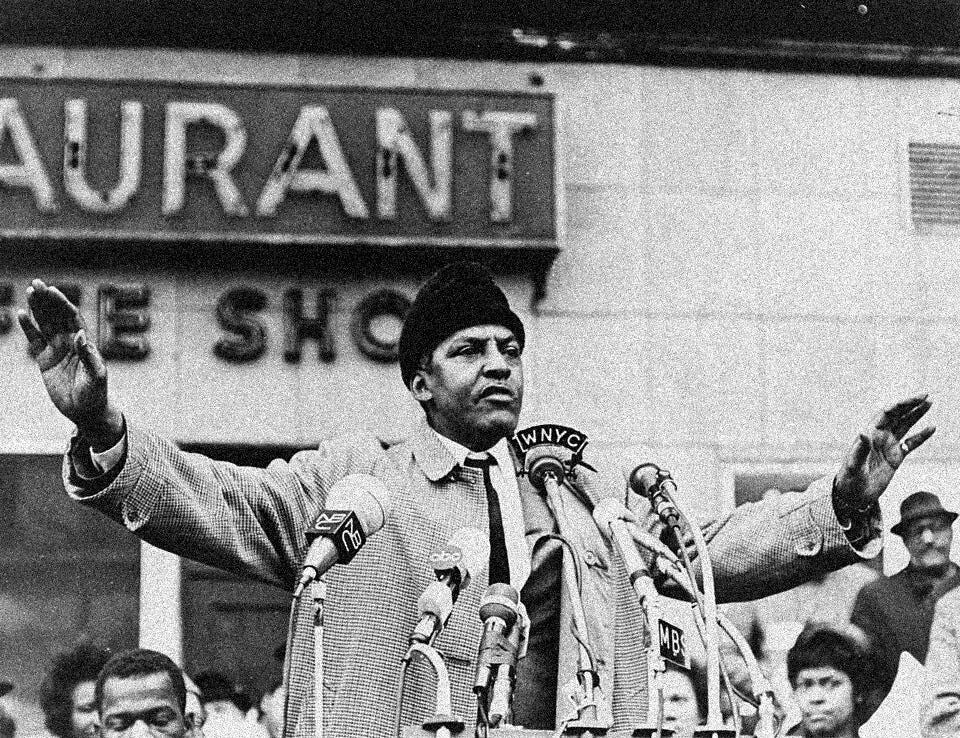
Rustin’s Challenge is officially out! Below is Benjamin Y. Fong’s introduction to the volume. You can order a copy today, or you can pick one up in person at our release events in Philly at 6pm on February 26th, and in NYC at 7pm on March 26th (at Verso, 207 E 32nd St, NY, NY 10016 - second floor). More events in the works.
The Left today is, amongst other things, a problem.
To paraphrase volume contributor Adolph Reed, Jr., it might be best to think of the contemporary “Left” as a collection of subcultural formations interloping where the Left has traditionally been. From online obsessions and organizational horizontalism to rigid identitarianism and maximalist politics, many of the tendencies of this unwieldy amalgam are anti-majoritarian. Every once in a while, whether by the force of a particular politician’s charisma or the strategic-mindedness of a subset of the Left, those tendencies can be constrained enough for the Left to have some electoral or organizational success. But the inadequacies and pathologies of the self-styled “radicals” of our day inevitably reassert themselves in destructive ways, and it’s worth being honest with ourselves at those moments that we’re dealing with signal, not noise.
The Right, unsurprisingly, has made great hay of the Left’s inadequacies. It’s convinced a great number of Americans that “the Left” stands for nothing more than that small but influential wing of the Democratic Party with odd, alienating cultural positions.
It may be too late to save the label from usages that corrupt it, but for our purposes, we will use “the Left” to identify that political tradition devoted to economic equality, political democracy, working class empowerment, and collective flourishing. It is in the name of that tradition and its pursuit of freedom and equality that we criticize the contemporary Left; that we wish to displace the collection of self-defeating tendencies comprising the “Left” with true organizations of democratic socialism. Without an honest reckoning with these tendencies and their deleterious consequences, the Right will be the only beneficiary of left stupidity, on which it feeds parasitically while offering no genuine solutions to our social crises.
There is no more important thinker in this task than Bayard Rustin. Rustin is best known as an itinerant civil rights leader, close advisor of Martin Luther King, Jr., and lead organizer of the iconic March on Washington for Jobs and Freedom in 1963. Rustin was also gay and a devoted pacifist—identities that kept him a marginal political figure, even while all close to him believed him to be a brilliant strategist and top-rate organizer. This is the Rustin that most people know, and the Rustin that was portrayed in the recent Netflix biopic, Rustin. In this version of his life, most everything important that he contributed happened before or on that momentous day of August 28, 1963.
This collection concerns a different Rustin: the post-1963 Rustin who encouraged civil rights and progressive activists to turn “from protest to politics,” and in so doing became a contentious, even reviled, figure on the Left. We concede that Rustin was a bit too hopeful about the political opening that the Lyndon Johnson administration provided, and that he was led by that hopefulness to tolerate a military Keynesianism that he surely would have criticized as a young man. But these mis-steps alone do not explain the intensity of the reaction against Rustin on the Left. To this day it is not uncommon to hear all manner of unfair accusations lodged against him, all to the effect that we can safely see the post-1963 Rustin as tragically compromised.
This move has the benefit of conveniently dismissing one of the most trenchant critics of a regressing liberal establishment and the New Left, both of whom he lambasted in the mid- and late-60s for turning their backs on the social and economic program needed to fulfill the promise of the Civil Rights movement and neglecting a political-economic analysis of the momentous tectonic shifts that were displacing workers. Indeed, we believe that the rejection of the post-1963 Rustin from the Left is less about Rustin himself and more about wanting to ignore the volley of critiques that we try to represent in this volume.
In “The Myth of the Racist Voter,” Rustin chides liberals for blaming the results of the 1972 presidential election on the “backwardness” of voters as a way of covering up their own failures. And in “Liberals and Workers,” he laments the new liberal tendency to devalue workers’ economic position, leading to identifications and problems that we today associate with identity politics. Rustin’s critique of new liberal tendencies in the late 1960s proved to be quite prescient. In a speech to the City Club of Cleveland from 1987, by which time the liberal bad habits Rustin identified in the later 1960s had settled into common sense, Rustin declared that there was only one way off the increasingly absurd road of “special privilege” that liberals had committed themselves to, and that was to re-embrace the politics of universalism. From what we’ve been able to gather, this speech, included in this volume, was Rustin’s last.
But Rustin only ever felt indirect sway over liberals, who he thought hesitant allies at best. His real object of concern from the mid-1960s on was the development of a misguided radicalism. In “Socialism or Moralism,” he laments the rapid emergence of an “obsessive moralism” on the Left, which “substitutes slogans for analysis.” In “The Kids, the Hardhats, and the Democratic Party,” he condemns the “kids” of the New Left for goading reaction on the Right and fracturing the liberal coalition. And in “The Alienated,” he attempts to make sense of where these self-defeating tendencies come from, specifically among the “alienated” youth. While Rustin disagreed fundamentally with the orientation and tactics of the new social movements, he understood where their particular form of “frustration politics” came from, and feared the consequences of not addressing the source of this frustration.
We face a situation in which, if there is not justice, and very soon, there are elements in our minorities who having rejected real progress, and acting on the basis of emotion, may well tear this society apart. As they say, if they cannot share equally in the American house, then they will burn it down.
Committed fully to the idea of a coalition between the key civil rights organizations and organized labor, and vocally opposed to the new “radical” tendencies emergent in the ‘60s, Rustin was unafraid of taking what we might consider today to be heterodox positions. They only appear “heterodox,” however, because the very alienation he warned of has become hegemonic on the Left. In “Growth, Jobs, and Racial Progress,” he criticizes the new tendency amongst environmentalists of his day to be anti-economic growth, a tendency that has only become more pronounced today on the climate Left. And in “Let’s Talk Sense About Crime,” he similarly goes after the idea that law enforcement as such is “anti-black” and urges the Left to take seriously the issue of crime that plagues poor and working-class communities.
For today’s Left, these two articles are a direct challenge to what has settled into common sense, though there are promising signs that some of the kneejerk attitudes on these topics are softening. Rustin also weighed in on many less contentious though still actively debated topics on the Left: in “Annual Guaranteed Income,” he offers what is still a helpful framing for proposals for what we call “universal basic income.” In “Imports Against Black Workers,” he rejects the notion that the erection of trade barriers is an inherently protectionist endeavor, correctly predicting the devastation to working-class communities that globalization would bring. And in “The Role of the Artist in the Freedom Struggle,” he steps back from politics to outline what he believes the task of the black artist is: “to reveal to all the human core of the human experience as seen through the black experience.”
It’s easy to look back at the Johnson administration, with the benefit of hindsight, and see little possibility for the revitalization of the New Deal coalition. But it’s important to remember just what a moment of political sea change the mid-1960s was. With the exit of the Dixiecrats, the Democratic Party was in the midst of a profound transformation wherein its base did substantively shift. That Rustin saw an opening for the civil rights and organized labor coalition to take a driving seat within the party was not that fanciful, yet it was treated that way by a curious number of people on the Left then and still on the Left today. It’s worth asking why that was and is. His critics on the Left are fine pillorying Rustin for his comments on anti-war protest tactics. But where are the similar condemnations of the New Left for sitting out the fight for the Freedom Budget for All Americans, arguably the last off-ramp from an imminent neoliberalism?
The Freedom Budget will receive later mention in these pages, but briefly, it outlined a federal budget to eliminate poverty in the United States within a ten-year period, with concrete proposals for improvements in jobs programs, housing, healthcare, and education. It was essentially a beefed up Bernie Sanders platform proposed through the A. Philip Randolph Institute and largely written by Rustin, and among the New Left it was ignored or hated. This should strike us, as it did Rustin, as worthy of investigation.
Why did the Left turn its back on a transformative economic and social program in favor of maximalist sloganeering and alienating tactics? Why did it begin to adopt a range of ideologically blinkered positions contrary in spirit to both the civil rights and labor movements? As anyone on the Left today knows, these are not simply historical questions. We continue to live in the wake of mid- to late-60s developments, even as majoritarian and universalist politics came roaring back to public consciousness with the Bernie Sanders campaigns.
A true Left for the twenty-first century will overcome the self-imposed limitations of the last fifty years and reground itself again in working-class organization and aspiration. This requires sound strategy and patient organizing work, but also a good hard look in the mirror. Even half a century on, it’s difficult not to catch a clear reflection of ourselves in Rustin’s writing. One can only hope that in another half-century, for leftists two generations from now, his critiques have lost their relevance.
Benjamin Y. Fong keeps a Substack on labor & logistics at ontheseams.substack.com.