

What Does America Believe?
Purposeless excitement effused in belief-reality.
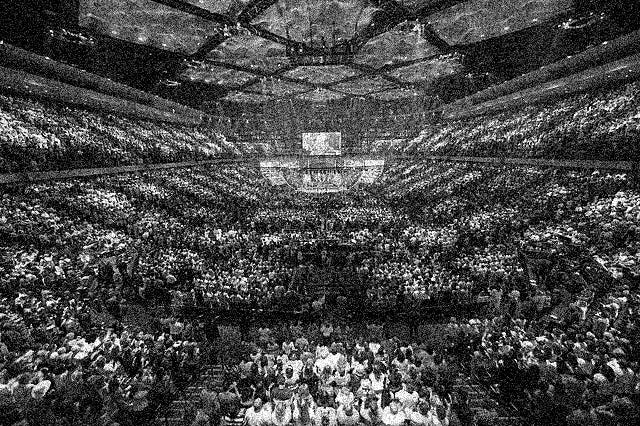
On May 10, 2019, Damage Magazine held a launch event in New York City. Amber A’Lee Frost and Bob Hullot-Kentor were invited to speak on the topic “What Does America Believe?” Bob Hullot-Kentor was unable to attend due to illness, and Damage editor Benjamin Fong gave a talk in his place. The talks were followed by a discussion moderated by Jeremy Cohan. What follows is an edited transcript of Benjamin Fong’s talk.
In the field where I did my graduate work (religious studies), there are many people who have made a career of pointing out that “belief,” being a specifically Protestant concept, is a bad lens through which to understand other “religions,” and in fact is a way of reducing the complexity of other religions to something akin to Protestantism. Belief, in other words, is a bad concept through which to understand the world. This isn’t wrong, of course, but it’s turned into a form of academic non-thinking, like calling Marx “Eurocentric.” And like any belief that is mobilized with an aggressive obviousness, it blinds its adherents to a certain possibility: in this case, that belief, in its very narrowness and narcissism, might actually convey something true about us: that we are a land of believers. Sometimes degraded concepts make sense of a degraded reality.
But is this self-criticism on the mark? Are Americans uniquely invested in the category of belief, in the idea that our beliefs matter, that we can mark ourselves by our beliefs? Is there a reason for this belief in belief? Another way of posing these questions would be to ask, are Americans uniquely ideological? And if so, why?
As an American, I have to believe that Americans are indeed particularly belief-prone, because when you’re stuck inside, it’s comforting to know that there’s an outside. I have to believe that non-Americans are nimbly abutting objective reality because if they’re not—if they’re like me, with the theme songs of sitcoms from the nineties going through their heads at all times—then the twelve-year timeframe within which the recent IPCC climate change report says we must decarbonize our economy really is much too long.
But if Americans are uniquely belief-stricken, why is this so? In what follows, I will offer two explanations that point in two different directions.
